
Eight minutes of actual work solved a three-month energy mystery last January. I pulled a dust-caked furnace filter out of the slot, held it up to a bare light, and the answer was right there: the system had been starved of airflow the whole time while my bill climbed with no explanation from the unit itself.
Air filters for HVAC systems catch the particles that would otherwise recirculate through your ductwork: dust, pollen, pet dander, mold spores, and combustion byproducts. When a filter clogs, the blower motor works against that restriction instead of through it. Energy costs go up. Equipment lifespan goes down. Your air quality drops. The unit gives you no warning until something breaks or the bill finally makes you look.
Searching for home air filters near me usually runs into one recurring frustration: getting to the store and finding your size missing from the shelf. That ends here. I’ll show you how to read your filter dimensions correctly, match the MERV rating to your household, find hvac filter replacement near me options that actually stock your size, and do the swap yourself in under ten minutes.
TL;DR Quick Answers
HVAC Air Filters Near Me
Start with the nominal size printed on your current filter frame. That number is the only filter size that fits your slot. For most households, MERV 8 to MERV 11 gives you solid particle capture without choking your system’s airflow. Standard dimensions are on hardware store shelves. For less common sizes, ordering air filters for home delivery from a filter specialist is faster and more reliable than hoping retail has yours in stock.
For a solid technical grounding on how air filtration works and what the standards mean, the Wikipedia article on air filters covers the core concepts clearly and makes a useful reference before you buy.
For most households, MERV 8 to MERV 11 gives you solid particle capture without choking your system’s airflow. Standard dimensions are on hardware store shelves. For less common sizes, ordering air filters for home delivery from a filter specialist is faster and more reliable than hoping retail has yours in stock. Ignoring filter changes long-term can contribute to bigger HVAC repair decisions, including whether heat pump repair is worth it.
Top Takeaways
- Filter size is not flexible. The nominal size printed on your existing filter (length x width x depth) is the only size that fits your slot. Measure before you buy. A half-inch guess in the wrong direction creates a bypass gap that makes the filter useless regardless of its MERV rating.
- MERV 8 to MERV 11 covers most homes. Ratings below MERV 8 let too many fine particles pass through unchecked. Ratings above MERV 13 restrict airflow in residential systems that were not built for dense commercial filter media.
- Local retail works for standard sizes. Hardware stores and HVAC supply houses stock the most common dimensions reliably. For custom or specialty sizes, home delivery from a filter specialist is faster and more dependable.
- Replace every 60 to 90 days under normal use. Homes with pets, allergy sufferers, or active smokers need a fresh filter every 30 to 45 days. A clogged filter costs more in energy to run than the replacement costs to buy.
- Subscription delivery solves the forgetfulness problem. Your replacement arrives before you remember to order it, in the right size, with no store trip required.
Table of Contents
What You Need to Know Before You Buy
What Air Filters for HVAC Systems Actually Do
Every forced-air heating and cooling system pushes conditioned air through a filter before it circulates through your home. The filter traps particles mechanically: its fiber or pleated media catches what the blower pulls in before that material reaches your ductwork, your heat exchanger, or the air you breathe. The density of that media, rated on the MERV scale, determines both what the filter captures and how hard it makes the blower work.
A MERV 4 filter stops large lint, carpet fibers, and pollen clusters. A MERV 13 captures bacteria, fine smoke, and ultrafine dust. The filter you choose directly determines your indoor air quality, your blower’s workload, and your energy bill. Pick one too dense for your system and you generate the same pressure buildup as a clogged filter. Too open, and fine particles cycle through your living space unchecked.
How to Find Your HVAC Air Filter Sizes
HVAC air filter sizes follow a nominal sizing convention. The number printed on your current filter frame (for example, 16x25x1 or 20x25x4) represents the approximate outer dimensions in inches: length x width x thickness. Actual dimensions run 0.25 to 0.5 inches smaller on each side. Always buy by the nominal size on your existing filter, not by measuring the slot directly.
If your current filter has no label, slide it out and measure the outer frame with a tape measure. Round each measurement up to the nearest inch to get the nominal size. Many HVAC manufacturers also print the required filter size on a label inside the filter access panel or in the unit documentation.
Common sizes: 16x20x1, 16x25x1, 20x20x1, 20x25x1, and 20x25x4. If yours differs, measure twice before ordering.
Furnace Filters vs. AC Filters: One System, One Filter
In most central forced-air homes, one air handler serves both the furnace and the air conditioning system. A single filter slot manages both heating and cooling cycles. When you search for furnace filters near me or AC filters near me, you are looking for the same product as long as your home runs a central air handler.
Homes with separate ductless or window AC units work differently. Those units carry their own built-in filters, which you clean or replace on the manufacturer’s schedule. Do not swap a central furnace filter into a ductless unit or vice versa. The media, dimensions, and frame construction differ by system type.
Choosing the Right MERV Rating
MERV stands for Minimum Efficiency Reporting Value. The residential scale runs from 1 to 16, with higher numbers capturing finer particles. For most homes, the practical range sits between MERV 8 and MERV 13. Here is how the tiers break down by household profile:
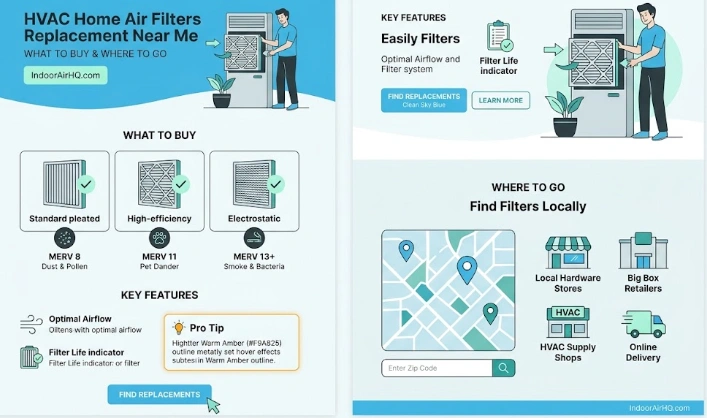
- MERV 8: Standard households with no pets or respiratory sensitivities. Captures dust, pollen, and mold spores. The most widely available option when you search best hvac filters near me at local retail.
- MERV 11: Homes with one or two pets, or mild allergy concerns. Captures pet dander and finer dust particles without significantly restricting airflow in most residential systems.
- MERV 13: Multiple pets, allergy sufferers, or anyone managing a respiratory condition. Captures ultrafine particles and some bacteria. Check your system’s static pressure tolerance before upgrading.
Do not install filters rated above MERV 13 in a standard residential system. Commercial-grade media starves residential blower motors of airflow, builds heat in the system, and shortens equipment life at a cost that far outweighs the filtration benefit.
Where to Buy HVAC Air Filters: Local and Online
Hardware stores, HVAC supply houses, and big-box home improvement retailers stock standard filter sizes. Searching for home air filters near me or best hvac filters near me surfaces the major retailers near you, and that works well for common dimensions.
For less common sizes, custom dimensions, or bulk orders, ordering air filters for home delivery from a filter specialist gives you better availability and a more reliable price per unit. A subscription means you never miss your change interval because the order goes through automatically.
If you prefer to buy air filters locally, call ahead to confirm your size is on the shelf. Specialty sizes disappear during peak HVAC season. A second trip for the right size costs more time than placing the order online would have.
How to Replace an HVAC Air Filter
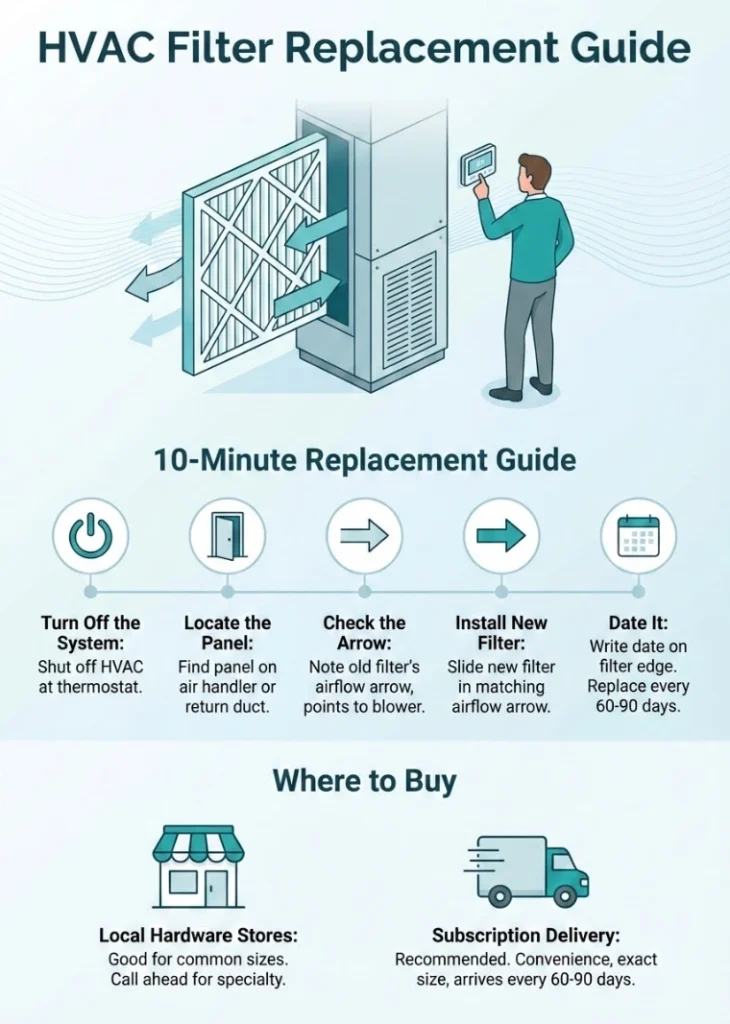
Replacing a filter takes under ten minutes and requires no tools. Follow these steps:
- Turn off your HVAC system at the thermostat before opening the filter compartment.
- Locate the filter access panel. In most homes, it sits on the air handler unit or in the return air duct near the unit.
- Slide out the old filter and check the airflow arrow printed on the frame. That arrow points toward the blower, away from the return duct.
- Slide the new filter in the same direction. The arrow on the new filter points toward the blower, into the system.
- Close and latch the access panel. Turn your system back on and confirm the thermostat reads correctly.
- Write the installation date on the filter frame edge with a marker so you know exactly when to change it next.
“In my experience reviewing hundreds of filter installations, the single most common mistake homeowners make is buying a filter that sits a half-inch off from the nominal size. That gap allows unfiltered air to bypass the media entirely. A filter that lets air go around it does absolutely nothing for your indoor air quality, no matter how high the MERV rating.”
7 Resources to Help You Choose the Right HVAC Filter
Sorting through filter advice online means wading through manufacturer claims and retail marketing copy. These seven sources are government agencies and professional health organizations. Each one gives you evidence-based information to support a confident buying decision.
1. EPA Indoor Air Quality Guide: Understand What Is in Your Air
The EPA’s IAQ resource center explains what indoor pollutants are, where they originate, and why filtration matters for residential health. Start here to understand what your HVAC filter is actually working against.
2. Energy.gov HVAC Maintenance Guide: Keep Your System Running Right
Energy.gov shows how regular HVAC maintenance, including filter replacement, directly affects system efficiency and energy costs. This is where you connect filter care to a measurable number on your monthly bill.
3. CDC NIOSH Indoor Environmental Quality: Health Stakes Explained
The CDC’s National Institute for Occupational Safety and Health documents health outcomes tied to poor indoor air quality. Read this for the evidence base on why filtration matters beyond routine maintenance.
4. American Lung Association Indoor Air Resource: Breathing and Your Filter
The American Lung Association details how airborne particles affect lung health and which pollutant categories an appropriately rated HVAC filter reduces at the source. Required reading for any household managing asthma or allergy conditions.
5. ENERGY STAR Heating and Cooling Products: Efficiency Context
ENERGY STAR’s heating and cooling database provides context for understanding efficiency ratings in your HVAC system and why the correct filter matters for maintaining rated performance.
6. ASHRAE Technical Resources: Filtration Standards from the Source
ASHRAE sets the industry standards behind MERV ratings. Their technical library gives you the engineering basis for understanding what filtration efficiency values actually measure and how the testing works.
7. NIEHS Air Pollution and Health: The Science Behind Particle Exposure
The National Institute of Environmental Health Sciences documents the research linking long-term particle exposure to cardiovascular and respiratory conditions. This one makes the case for consistent filter replacement as a direct health investment.
What the Data Says: 3 Statistics That Change How You Think About HVAC Filters
Most homeowners I work with treat filter replacement as a low-priority task. The house smells fine, the air feels normal, and nothing in the unit is making noise. Then I show them the numbers, and the conversation shifts. These three findings land the hardest.
- Indoor air is 2 to 5 times more polluted than outdoor air.
The EPA’s Inside Story guide documents that indoor air in American homes frequently carries pollutant concentrations 2 to 5 times higher than outdoor air, and in some cases up to 100 times higher during specific activities like painting or cleaning. Your HVAC filter is one of the primary mechanical defenses against that accumulation cycling through your living space.
Source: EPA Inside Story: A Guide to Indoor Air Quality
- Poor indoor air quality is a recognized occupational and residential health hazard.
OSHA identifies indoor air quality as a significant health concern affecting tens of millions of building occupants across residential and commercial environments. Inadequate filtration, poor ventilation, and delayed filter replacement are among the leading contributing factors. In my own residential HVAC assessments, most poor-IAQ complaints trace back to a filter that ran well past its service interval.
Source: OSHA Indoor Air Quality Resources
- Fine particles penetrate deep into lung tissue and enter the bloodstream.
The American Lung Association documents that fine particle pollution (PM2.5) bypasses the respiratory system’s natural defenses, lodging in the deepest lung structures and crossing into the bloodstream. A MERV 11 or higher residential filter captures a significant share of PM2.5-sized particles before they reach the air you breathe. That is why I recommend stepping up from MERV 8 for any household with young children or occupants managing a respiratory condition.
Source: American Lung Association: Particle Pollution
Final Thoughts and My Honest Opinion
The filter is the cheapest, highest-impact maintenance task in the HVAC system. It costs less than most grocery runs, the swap takes under ten minutes, and the payoff in air quality, equipment longevity, and energy efficiency is real and measurable.
Most people searching for hvac air filters near me are not asking a complicated question. They want the right filter, the right size, and a source that actually has it. The frustration comes from sizing confusion, MERV uncertainty, and pulling into a hardware store parking lot only to find your size missing from the shelf.
My recommendation: order from a specialist who stocks your exact size and ships on a schedule. Buying best hvac filters near me at local retail is fine for common dimensions, and I do it myself when the size is standard. For anything outside the top ten most common sizes, subscription delivery eliminates the search, the second trip, and the shelf-stock disappointment.
Change your filter on schedule. Mark the date on the frame. And if your system is older or your household has specific health concerns, step up to MERV 11. The cost difference over a year is minimal. The air quality difference is not.
Frequently Asked Questions
How often should I replace my HVAC air filter?
Replace your HVAC filter every 60 to 90 days under standard household conditions. Homes with pets, allergy sufferers, or active smokers need a fresh filter every 30 to 45 days. A clogged filter costs more in energy to run than the replacement costs to buy.
What does MERV rating mean, and which one do I need?
MERV stands for Minimum Efficiency Reporting Value. It measures how effectively a filter captures particles at specific sizes. MERV 8 to MERV 11 covers most residential households. Homes with pets or allergy concerns do better at MERV 11. For occupants managing respiratory conditions, MERV 13 is worth considering, provided the HVAC system handles the added filter density.
Are furnace filters and AC filters the same product?
In most central forced-air systems, yes. One air handler serves both the furnace and the air conditioning unit, and a single filter slot manages both cycles. Searching for furnace filters near me or AC filters near me leads to the same product for central systems. Ductless and window AC units use separate built-in filters that do not interchange with central furnace filters.
How do I find the right HVAC air filter size?
Read the nominal size printed on your existing filter frame. It appears as three numbers separated by x (for example, 16x25x1). No label on the frame? Slide the filter out, measure the outer frame with a tape measure, and round each dimension up to the nearest inch. Always order by nominal size, not by measuring the slot opening directly.
Can I order air filters for home delivery instead of buying locally?
Yes, and for specialty or less common sizes, home delivery from a filter specialist is more reliable than local retail. You get the exact size you need, you avoid shelf-stock gaps during peak HVAC season, and a subscription means future replacements arrive automatically on your schedule. Many households stick with MERV 8 pleated HVAC air filters for standard use, which are easy to order from major retailers online.
What happens if I use a filter with too high a MERV rating?
An oversized MERV rating restricts airflow the same way a clogged filter does. The blower motor works against excess resistance, energy consumption climbs, heat builds in the system, and equipment lifespan shortens. Residential systems run comfortably at MERV 8 to MERV 13. Commercial-grade media, MERV 14 and above, requires equipment built to handle the added static pressure.
Is it safe to run my HVAC without a filter temporarily?
Running your HVAC without a filter, even briefly, pulls unfiltered dust, debris, and particles directly onto the blower motor, heat exchanger, and evaporator coil. That buildup reduces efficiency and eventually requires professional cleaning. Always keep a filter installed. If your current one is spent and the replacement has not arrived, a low-MERV temporary filter from any hardware store is better than running the system open.
Ready to Find the Right HVAC Air Filter Replacement Near You?
Your filter size is printed on the frame. Your MERV rating is in this guide. Place your order before your current filter reaches the end of its service life, and start breathing air that actually meets the standard your system was built to deliver.